Morris Lubricants in agriculture - Part of the solution, not part of the problem
The agricultural industry continues to make huge strides in the adoption of different sustainable farming practices. This includes the use of agricultural and farming vehicles that are becoming more sustainable and are therefore having a lesser effect on the environment. In recent years there has been a huge number of advances in engine designs and technologies to reduce vehicle emissions in tractors, combines, telehandlers, diggers, dumpers and trucks alike. These engine designs promote better fuel economy as well include the use of aftertreatment devices such as Diesel Particulate Filters (DPFs) to help eliminate emissions.
With its wide range of agricultural oils, designed for use in tractors, combines, bailers, telehandlers and other farming equipment, Morris Lubricants has been a key supplier to the agricultural sector for decades. As part of its corporate strategy, the company supports the need to review any environmental impact and establish ways to support the drive for improved sustainability in the agricultural industry. This is to be achieved by not only improving the daily operations, manufacturing processes and logistics to lessen the company’s impact on the environment but also by constantly improving the Morris Lubricants’ agricultural products to help meet the need for cleaner and more efficient oils and lubricants.
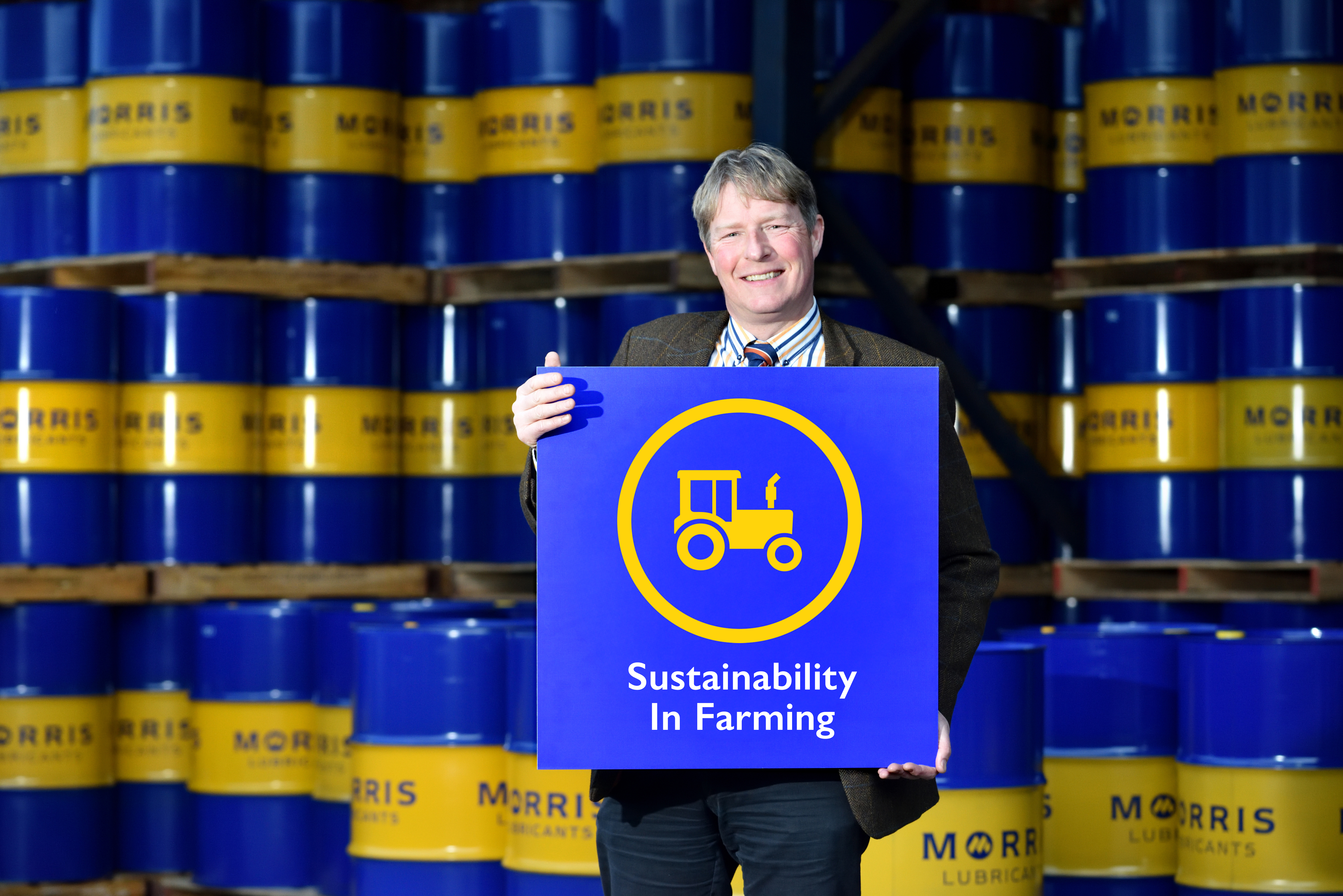
In this article, Morris Lubricants’ Executive Chairman, Andrew Goddard, highlights some of the company’s approaches to sustainability.
Andrew states, “I often get asked how a business that supplies petroleum-based oils and lubricants can be truly sustainable and my answer is always the same. The lubricants industry must be seen as part of the solution and not part of the problem”.
In the agricultural and farming world, the path to reduced emissions in the vehicles used is a challenging one. There is a continual focus on ensuring agricultural and farming vehicles become more fuel efficient – and the natural solution tends to fall on engine technology.
Since the 1990s, continued legislation has driven vehicle emissions downwards, but to achieve this, engine and exhaust system modifications have been made. A variety of emission reduction technologies have been introduced to agricultural vehicle engines to control the levels of NOx gases and particulate matter (the harmful solid debris in the exhaust gas stream).
The use and continued effectiveness of these emission reduction systems have always depended on the quality and performance of the engine oils used. Another important way to reduce energy consumption, is to consider the reduction of friction. A huge amount of energy consumption can be attributed to friction, component wear and corrosion. Also engine and vehicle failures can be attributed to incorrect oil use, lack of regular oil changes, and lubrication breakdown.
To put it simply – it is incumbent on us, as manufacturers of an essential component in the smooth functioning of agricultural engines and transmissions to do everything we can to make our oils and lubricants cleaner and more efficient. This means extracting the maximum benefit from every single molecule, while also exploring the economic feasibility of synthetic fuels and bio lubricants.
The equation is simple. Using lubricants correctly can help reduce friction, which in turn reduces energy use – so ensuring we manufacture quality our oils that perform to the correct standards and Original Equipment Manufacturers (OEM) specifications is key.
The drive for improved sustainability cannot be delivered through advanced oil formulations and product innovations alone. As manufacturers we must also make and distribute our products with sustainability in mind and examine every part of our business operations, throughout the whole of the value chain and production cycle.
An action plan for success
Over several years, we have developed an action plan to improve our sustainable credentials and minimise our environmental impact, with a goal to reach net zero emissions by 2040.
We have aligned our sustainability strategy with the United Nation’s Sustainable Development Goals, which includes supporting the fundamental principles of sustainable industrialisation, fostering innovation, supporting sustainable consumption, reducing energy use, reducing waste along with establishing partnerships to develop a more sustainable and carbon neutral lubricants industry.
This long-term approach means that we are looking for and implementing ongoing improvements in all that we do. Some of which will last for generations to come, and this is where I feel most proud.
Let me tell you about some of our sustainable approaches we have taken in the manufacturing and distribution of our quality oils and lubricants:
· We have switched to Hydrotreated Vegetable Oil (HVO) as a fuel alternative for our delivery fleet. HVO is synthesised from 100 per cent renewable raw materials such as vegetable oils, animal oils and fats, which reduces net CO2 greenhouse gas emissions.
· At our Shrewsbury manufacturing facility, we use electricity generated on site from our own solar panels, and we also purchase zero carbon energy from the electricity Grid.
· Ultrasonic blending technology is used, which reduces the need for heat during manufacturing different oil formulations, which helps reduce energy consumption.
· The use of artificial dyes in our products is being reviewed and where possible, reduced in their use as dyes can be harmful to the environment.
· Our preference is to provide our products in metal packaging, which can be recycled over and over again.
· Where plastic is specified, we use containers made from 35 per cent recycled plastic
· We regularly conduct energy and production management analysis throughout our manufacturing process to help reduce waste and improve efficiencies
We are also proud that our key suppliers abide by our code of conduct, improving supply chain transparency and ensuring that we use only raw materials that comply with all applicable environmental, health and safety standards.
As well as focusing on the company’s sustainable and environmental footprint, Morris Lubricants also runs several Corporate Social Responsibility (CSR) projects. The company has a commitment towards our employees as well as to the communities in which we operate in, to consider our broader economic and social responsibilities. The company believes in investing in its employees and provides education and training for our teams at all levels covering all sorts of formal qualifications from apprentice schemes to senior management development.
In the local community, we support local charities where every pound raised has a real positive impact to their cause. The company also supports several local grassroots sports teams and grounds, that often provide a social space and positive mental wellbeing for those that take part, support the teams and use the facilities.
Being part of the solution is not without its challenges. It requires constant refinement of our processes – and hard work from all our colleagues – but we are well on course to achieve net zero emissions and can’t wait to see where the journey takes us!
Over several years, Morris Lubricants has been developing an action plan in a continued effort to become more sustainable and cement the company’s commitment to minimising its impact on the environment. By taking a group-wide approach and focusing on the various criteria set by EcoVadis, Paterson Enterprises, Morris Lubricants’ parent company is proud to announce that it has achieved the prestigious Gold award rating for 2025 for operations around the Morris Lubricants' site in Shrewsbury.
The Gold EcoVadis puts the company in the top five per cent of companies globally. Due to the nature of the company structure, the 2025 award is listed under Paterson Enterprises Ltd (Shrewsbury Site). The award is in recognition of activities and initiatives that have taken place throughout 2025. EcoVadis assesses over 130,000 companies globally on an annual basis and this award recognises companies for their sustainable practices and their relationships with trading partners. Assessment criteria covers four sustainability pillars: the environment, ethics, labour and human rights and sustainable procurement. The detailed sustainability action plan is a long-term commitment.
The EcoVadis journey started with the bronze award in 2022 and fast forward three years the company has now taken the huge leap to achieve the gold award. After achieving this high accolade, the company has already begun working hard to retain the gold award in 2026.
Andrew Goddard concluded: " We work in an industry that does not stand still. It constantly faces new and significant challenges to its products, customers and markets, but we remain committed to improving our sustainability credentials in this changing marketplace."